Choosing the right industrial pump parts is rarely a simple catalog exercise. A seal may look correct, yet fail after weeks of heat, pressure, or abrasive service. In field maintenance, small dimensional differences can create leakage, vibration, and costly downtime. The right decision begins with the pump model, operating conditions, and failure history. Record the fluid, temperature, pressure, flow rate, speed, and installation environment before ordering. Details matter.
This guide explains how to compare materials, tolerances, performance ratings, and supplier documentation. It considers wet-end components, mechanical seals, bearings, gaskets, impellers, wear rings, and drive elements. Stainless steel is not automatically better. Compatibility depends on chemistry, concentration, temperature, and duty cycle. A cheaper component can become expensive when replacement labor and lost production are included. Verify drawings, dimensions, certifications, and traceability. Ask for test evidence where the application is critical.
Reliable selection also requires practical judgment. A maintenance technician may notice scoring on an old shaft, while a process engineer identifies pressure fluctuations. Their observations should be reviewed together, not kept in separate reports. Yet no guide can replace site inspection. I have seen apparently correct parts perform poorly because the original pump had been modified. That possibility deserves attention. Compare each part with the actual assembly, confirm clearances, and review the supplier’s technical support. The goal is steady, safe performance, not merely a part that fits today. Good choices reduce repeat failures and make future maintenance more predictable.
Choosing industrial pump parts starts with the operating conditions, not the equipment catalog. Record flow rate, discharge pressure, fluid temperature, viscosity, pH, and solids content. Check suction pressure and available NPSH under the worst condition. A clean liquid at 20°C requires different seals and bearings than abrasive slurry at 80°C. The U.S. Department of Energy reports that pumping systems can consume about 25% of electricity in industrial facilities. Therefore, an incorrectly sized impeller can increase energy use and accelerate wear.
Service requirements also define the correct replacement parts. Continuous operation needs bearings and seals rated for extended duty. Frequent starts may require stronger couplings and improved thermal control. Corrosive fluids demand compatible metallurgy, while suspended particles can damage wear rings and mechanical seals. Review maintenance records, vibration readings, leakage patterns, and previous failure locations. ISO 5199 and Hydraulic Institute guidance both stress matching pump construction with duty conditions. Still, a specification sheet can mislead when actual site conditions have changed.
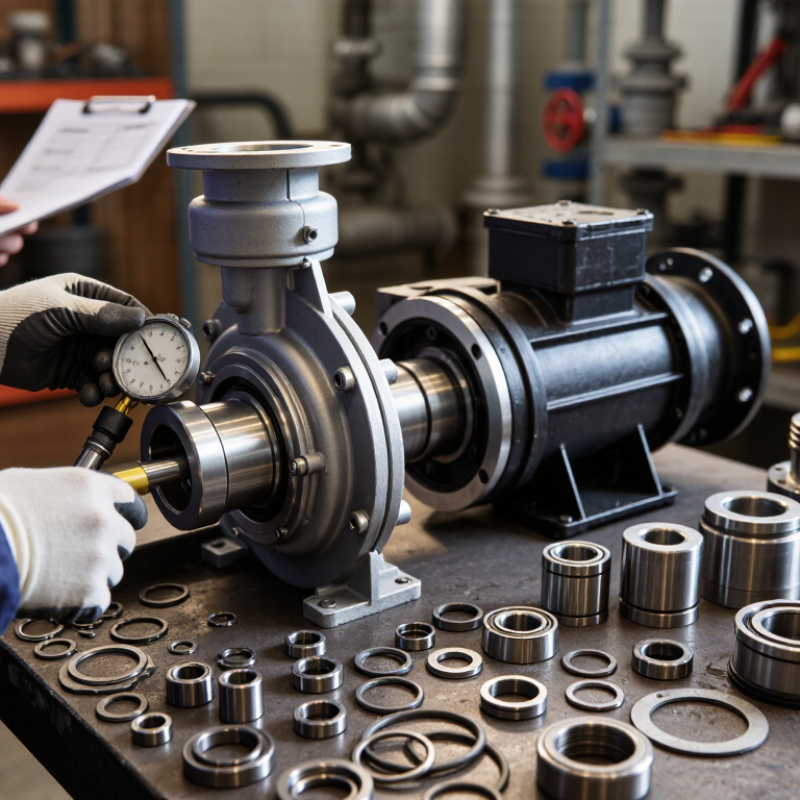
Tips: Photograph the failed part before removal. Measure shaft wear, seal faces, and impeller clearance. Compare real readings with the original design point. Do not rely only on the nameplate. A small mismatch matters. In one common maintenance mistake, operators select a seal by size but ignore temperature and chemical compatibility. That choice may appear economical, yet repeated leakage creates downtime and safety concerns. Recheck the duty cycle after every process modification.
| Operating Condition | Typical Service Information | Pump Parts Affected | Selection Guidance | Key Verification Points |
|---|---|---|---|---|
| Pumped Fluid | Water, hydrocarbons, chemicals, wastewater, slurry, or process liquids | Casing, impeller, shaft, wear rings, gaskets, mechanical seal | Select wetted materials according to the fluid’s chemical compatibility, density, lubricity, and contamination level. Common material choices include cast iron, carbon steel, stainless steel, duplex stainless steel, bronze, and engineered plastics. | Confirm fluid composition, concentration, pH, chloride content, toxicity, and whether the liquid crystallizes or polymerizes. |
| Flow Rate | Required flow in m³/h, L/min, or US gpm at the duty point | Impeller, diffuser, volute, suction components, shaft | Choose parts that match the design flow and the pump’s best efficiency region. Oversized or incorrectly trimmed impellers can increase power consumption, vibration, and internal recirculation. | Compare rated flow, minimum continuous stable flow, maximum flow, and the actual system curve. |
| Differential Head or Pressure | Static head, friction losses, discharge pressure, and required differential pressure | Impeller, casing, diffuser, pressure-containing gaskets, shaft | Use an impeller diameter, number of stages, and pressure class suitable for the required head. Pressure-containing components must be rated for the maximum allowable working pressure and temperature. | Include startup, shutdown, blocked-discharge, surge, and relief-valve conditions in the pressure review. |
| Liquid Temperature | Cold service, ambient-temperature service, hot water, thermal oil, or high-temperature process liquid | Mechanical seal, elastomers, bearings, gaskets, casing, shaft coating | Select seal faces, elastomers, gaskets, and lubricants for the complete temperature range. High temperature can reduce elastomer life, alter clearances, and accelerate lubricant degradation. | Verify continuous temperature, transient temperature, heat soak after shutdown, and minimum temperature during startup. |
| Viscosity | From low-viscosity water-like fluids to oils, polymers, and other viscous liquids | Impeller, shaft, coupling, motor, bearings, mechanical seal | For viscous liquids, account for reduced flow and head and increased power demand. A larger shaft, stronger coupling, modified impeller geometry, or a positive-displacement pump may be required for very viscous service. | Use operating viscosity at pumping temperature, not only the fluid’s room-temperature viscosity. |
| Solids Content and Particle Size | Clean liquid, suspended solids, abrasive particles, fibrous material, or sludge | Impeller, wear plates, casing, suction cover, mechanical seal | Use open, semi-open, vortex, recessed, or non-clog impeller designs when solids are present. Abrasive slurry may require hardened or elastomer-lined wetted parts and replaceable wear components. | Record solids concentration, hardness, particle size, shape, specific gravity, and the possibility of rags or fibrous debris. |
| Corrosion and Chemical Compatibility | Acidic, alkaline, saline, oxidizing, reducing, or solvent-containing fluids | Casing, impeller, shaft sleeve, fasteners, seal faces, gaskets | Match materials to the fluid and temperature. Stainless steels, duplex alloys, nickel alloys, ceramics, fluoropolymers, and other engineered materials may be suitable depending on the chemical environment. | Review corrosion rate, pH range, chloride exposure, galvanic couples, crevice conditions, and chemical-cleaning procedures. |
| Net Positive Suction Head | Available NPSH compared with the pump’s required NPSH | Impeller eye, suction cover, inlet wear ring, suction piping interface | Select a pump and impeller configuration that provides adequate NPSH margin. Poor suction conditions can cause cavitation, leading to pitting, vibration, noise, and rapid impeller damage. | Calculate NPSH available at the worst liquid temperature, lowest tank level, and maximum flow condition. |
| Rotational Speed | Fixed-speed or variable-speed operation; commonly 1,450 or 2,900 rpm at 50 Hz, subject to equipment design | Shaft, bearings, impeller, coupling, mechanical seal | Ensure the shaft, bearings, impeller balance, seal, and coupling are rated for the full operating speed range. Higher speed generally increases hydraulic performance but may increase wear and vibration sensitivity. | Confirm maximum continuous speed, critical speed separation, balance grade, overspeed protection, and allowable vibration. |
| Mechanical Seal Requirements | Clean or contaminated liquid, low or high pressure, hot service, hazardous or volatile fluid | Seal faces, elastomers, springs, gland, shaft sleeve, flush system | Select single or dual mechanical seals, face materials, elastomers, and flush arrangements according to pressure, temperature, solids, lubrication, and leakage-control requirements. | Confirm seal chamber pressure, face lubrication, flush-plan requirements, leakage limits, and dry-running risk. |
| Bearing and Lubrication Conditions | Oil-lubricated or grease-lubricated bearings; high load, high speed, humid, or contaminated environments | Radial bearings, thrust bearings, bearing housing, oil seals, grease fittings | Select bearings for the combined radial and axial loads, operating speed, and expected service life. Use the specified lubricant type and maintain correct oil level or grease quantity. | Review bearing load, temperature, lubrication interval, contamination protection, alignment, and shaft deflection. |
| Shaft and Coupling Load | Continuous duty, frequent starts, variable-speed operation, or high-torque service | Pump shaft, shaft sleeve, coupling, key, keyway, spacer | Choose a shaft and coupling with sufficient torsional strength, fatigue resistance, and corrosion resistance. A shaft sleeve can protect the shaft in the seal and packing areas. | Check torque, bending moment, shaft deflection at the seal, coupling alignment, key fit, and start-stop frequency. |
| Packing Instead of Mechanical Seal | Applications where controlled leakage is acceptable and maintenance access is available | Packing rings, lantern ring, packing gland, shaft sleeve | Use packing materials compatible with the liquid and temperature. Packing requires controlled adjustment and normally needs a small, continuous leakage rate for cooling and lubrication. | Confirm allowable leakage, flushing-water quality and pressure, sleeve condition, and adjustment procedure. |
| System Cleanliness and Installation | New installation, retrofit, temporary service, or systems exposed to welding debris and scale | Mechanical seal, impeller, wear rings, bearings, coupling, gaskets | Install suction strainers or temporary screens where appropriate, flush the system, remove welding slag, and verify pipe alignment before commissioning. Foreign material can damage close-clearance parts and seals. | Inspect pipe supports, flange alignment, baseplate condition, soft foot, shaft rotation, and suction-line cleanliness. |
| Maintenance and Spare-Part Strategy | Critical continuous-process service, seasonal duty, remote location, or limited maintenance access | Seal kit, bearings, gaskets, wear rings, sleeves, impeller, coupling elements | Prioritize parts with predictable wear and keep critical replacement items available. Use dimensional records and material certificates to ensure replacement parts match the pump’s original design. | Record pump model, serial reference, shaft diameter, impeller diameter, seal dimensions, material grades, and clearance limits. |