Top Twin Shaft Concrete Mixer Manufacturers Worldwide
Choosing reliable equipment begins with understanding how a mixer performs beyond its brochure specifications. This guide examines top twin shaft concrete mixer manufacturers worldwide, focusing on engineering quality, production consistency, service support, and practical site performance. It also explains why Twin Shaft Mixer Concrete systems remain popular for demanding batching applications.
A well-designed mixer combines aggregates, cement, water, and additives quickly and evenly. Two counter-rotating shafts create strong circulation throughout the mixing chamber. Paddles must maintain effective contact with the material. Discharge gates should open cleanly, without leaving heavy residue. Wear-resistant liners matter when crews process abrasive stone every day. Small details become expensive problems.
Manufacturer evaluation requires more than comparing output figures. Experienced buyers inspect shaft seals, gearbox protection, paddle adjustment, maintenance access, and spare-parts availability. They also review installation records and customer feedback from similar climates. A trusted manufacturer should provide testing data, clear manuals, and realistic service commitments. Claims still need verification. No ranking is perfect.
This overview considers manufacturers with established technical capabilities, documented applications, and responsive after-sales networks. It recognizes that a mixer suitable for precast production may not fit ready-mix or soil stabilization work. Moisture variation, aggregate size, batch volume, and local maintenance skills can change the decision. Practical experience often reveals weaknesses that catalogues hide. That matters.
Readers can use these criteria to compare equipment more confidently and identify suitable suppliers for their projects. The strongest choice is rarely the cheapest machine. It is the mixer that delivers stable batches, manageable maintenance, and dependable support over years of operation. Performance must be proven.
What a Twin Shaft Concrete Mixer Is and How It Works
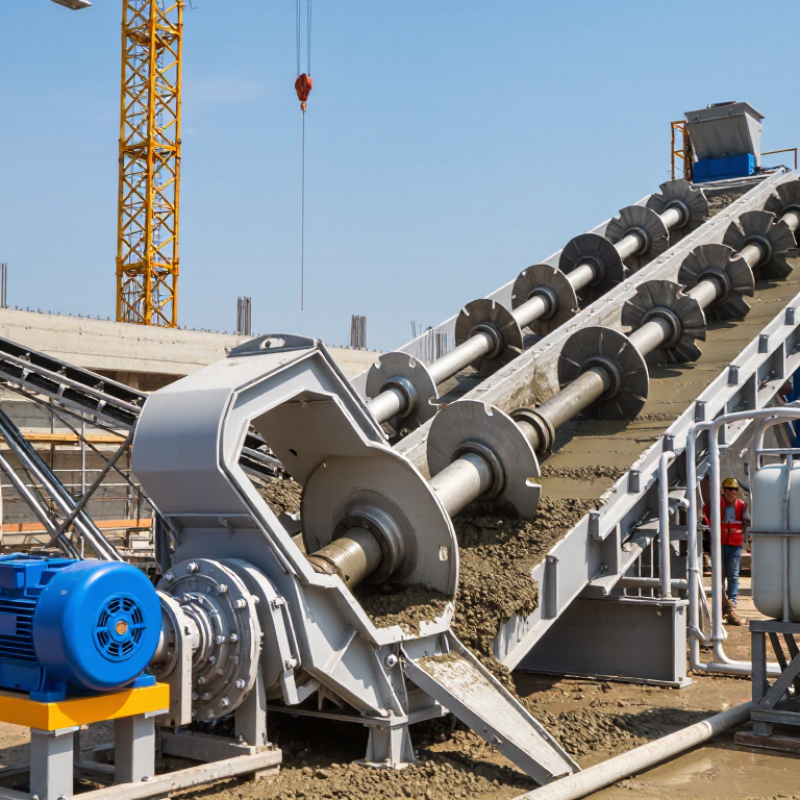
A twin shaft concrete mixer uses two horizontal shafts fitted with overlapping paddles. The shafts rotate inward, lifting and folding aggregates, cement, water, and admixtures through the mixing chamber. This creates strong three-dimensional movement instead of simple drum rotation. The result is a more uniform blend in a shorter cycle.
The details matter.
The USGS Mineral Commodity Summaries 2024 reported about 4.1 billion metric tons of global cement production in 2023. At this scale, small mixing losses can become expensive material waste. The GCCA’s 2050 Climate Ambition describes cement and concrete as contributing roughly 7% of global carbon dioxide emissions. Efficient mixing therefore supports both production control and resource management.
In practical use, operators check moisture, loading sequence, shaft speed, and discharge time. A properly filled chamber should show consistent paste coating on coarse aggregate, not dry pockets near the sidewalls. ASTM C94/C94M provides requirements for ready-mixed concrete, but compliance still depends on testing and disciplined operation. A twin shaft mixer is not a magic solution. Poor calibration, worn paddles, or excessive filling can reduce uniformity. I would also question any performance claim without test batches, slump checks, and strength results. Real conditions are messier than brochures suggest.
Key Features That Define High-Quality Twin Shaft Mixers
Top Twin Shaft Concrete Mixer Manufacturers Worldwide
High-quality twin shaft mixers are defined by controlled energy, not impressive brochure claims. Their two horizontal shafts should create fast, three-dimensional movement, while synchronized paddles prevent dead zones near the walls. A rigid frame matters. It limits vibration when mixing dense concrete containing coarse aggregate.
According to the Global Cement and Concrete Association’s 2024 roadmap, cement and concrete contribute roughly 7% of global carbon dioxide emissions. Efficient mixing therefore has practical value. A mixer that reaches uniformity quickly can reduce wasted power, rejected batches, and unnecessary reprocessing. ASTM C94/C94M also emphasizes concrete uniformity, including consistency and aggregate distribution. Buyers should request test results, not promises. Check mixing time, moisture variation, discharge residue, and batch-to-batch consistency under realistic loads.
Small details matter. Replaceable wear liners should be thick, accessible, and secured against loosening. Sealed bearings need protection from cement dust and wash water. Torque monitoring can reveal overloads before mechanical damage becomes expensive. Operators should inspect paddle clearance regularly, especially after using abrasive aggregates. No mixer is perfect. Even well-designed equipment may leave uneven moisture if loading is rushed or materials vary. That limitation deserves honest testing. A useful acceptance trial records at least three consecutive batches, using the plant’s actual recipe, aggregate size, and production speed.
How to Compare Twin Shaft Mixer Manufacturers Worldwide
Comparing twin shaft concrete mixer manufacturers worldwide requires more than reading capacity charts. Examine mixing performance, build quality, and documented field experience. Ask for test results using your target aggregates, moisture levels, and cement ratios. A reliable manufacturer should explain discharge time, power demand, wear protection, and shaft alignment clearly. Request production records from projects with similar climates and output requirements. Factory visits can reveal welding quality, machining accuracy, spare-part storage, and actual assembly practices.
Technical support often separates a strong supplier from an attractive brochure. Check response times, commissioning procedures, operator training, and remote troubleshooting options. Confirm whether critical parts are locally available and how long replacements normally take. Review warranty terms carefully, including exclusions for abrasive materials and improper maintenance. I have found that impressive specifications can hide ordinary service systems. That deserves honest attention. Also compare lifecycle cost, not only purchase price. Energy use, liner replacement, downtime, and cleaning labor may change the final decision.
Tips: Build a comparison sheet with identical questions for every manufacturer. Record shaft speed, batch volume, motor rating, wear-part thickness, and delivery promises. Request customer references, but verify them independently. If possible, inspect a running mixer and observe the discharge texture. Uneven concrete may indicate poor loading, worn paddles, or incorrect moisture control. Leave room for uncertainty; early assumptions are sometimes wrong.
Global Twin-Shaft Concrete Mixer Manufacturer Comparison Context
Cement production is a practical demand indicator when comparing twin-shaft concrete mixer manufacturers worldwide. Higher-production markets generally require more batching plants, infrastructure projects, replacement equipment, and after-sales support. The figures below show estimated 2023 cement production in selected markets and should be used as market context rather than manufacturer output.
Source: U.S. Geological Survey, Mineral Commodity Summaries 2024. Values are rounded estimates in million metric tons.
Major Applications for Twin Shaft Concrete Mixing Equipment
Twin shaft concrete mixers serve demanding production environments where uniformity, speed, and moisture control directly affect product quality. The Global Cement and Concrete Association reports that the world produces approximately 14 billion cubic metres of concrete annually. This volume supports housing, bridges, tunnels, ports, and industrial foundations.
Precast plants use twin shaft mixers for stiff concrete, dry-cast products, and heavily reinforced components. Their counter-rotating shafts shorten mixing cycles and distribute cement paste around aggregates more consistently. Ready-mix facilities also use them when recipes contain supplementary cementitious materials, fibers, or chemical admixtures. Small moisture changes matter. A 1% variation can influence slump, strength, and finishing behavior, especially in low-water mixes.
Large infrastructure projects often apply twin shaft equipment to roller-compacted concrete, pavement bases, and soil-cement stabilization. The International Energy Agency identifies cement production as responsible for roughly 8% of global energy-related and process carbon dioxide emissions. Better mixing cannot solve that burden alone, but it can reduce rejected batches and unnecessary material use. That claim needs site-level verification. Operators should compare cycle time, batch consistency, water correction, and maintenance records before choosing capacity. A mixer that looks efficient on paper may struggle with sticky recycled aggregates or frequent recipe changes. Temperature, aggregate grading, and operator discipline still decide the final result.
Essential Factors for Selecting the Right Manufacturer and Model
Top Twin Shaft Concrete Mixer Manufacturers Worldwide
Selecting the right twin shaft concrete mixer requires more than comparing catalogue capacity. The USGS Mineral Commodity Summaries 2024 estimates global cement production at about 4.1 billion metric tons in 2023. That scale increases pressure on plants to maintain output, consistency, and uptime. A suitable manufacturer should provide verified batch results, not only attractive specifications. Ask for test data using your actual aggregate size, moisture range, admixture dosage, and target slump. A 3-cubic-meter mixer may perform differently with heavy recycled aggregate.
Mixing intensity matters, but excessive power can raise operating costs and accelerate wear. The IEA reports that cement production contributes roughly 7% of global carbon dioxide emissions. Energy-efficient drives, short mixing cycles, and accurate water control therefore deserve serious attention. Review motor power per batch, discharge time, dust control, and cleaning requirements. Check whether wear liners, paddles, seals, and bearings are available locally. Small delays become expensive during continuous production.
Manufacturer reliability also depends on engineering support. Request references from plants with similar recipes and daily workloads. Inspect shaft alignment, gearbox protection, emergency access, and maintenance records. Confirm compliance with applicable safety and electrical standards. I would not trust a promise of “uniform mixing” without independent testing or a documented acceptance procedure. Price comparisons often ignore service response time. That is a mistake. A lower initial quote may conceal difficult maintenance, weak commissioning support, or frequent liner replacement. The best model is the one that remains measurable, serviceable, and stable under real site conditions.
Top Twin Shaft Concrete Mixer Manufacturers Worldwide - Essential Factors for Selecting the Right Manufacturer and Model
| Manufacturer Profile | Typical Application | Nominal Batch Volume
(m³) | Typical Output
(m³/h) | Installed Power
(kW) | Maximum Aggregate Size
(mm) | Recommended Selection Factors |
| Compact stationary configuration | Precast components, small ready-mix plants and construction sites | 0.5–1.0 | 20–50 | 22–45 | 40–50 | Choose a compact footprint, easy access for cleaning, and a discharge gate suited to frequent batch changes. |
| Medium-duty commercial configuration | General ready-mix production and precast concrete manufacturing | 1.5–2.0 | 60–100 | 55–90 | 50–60 | Prioritize mixing uniformity, replaceable wear parts, reliable weighing integration and locally available electrical components. |
| High-throughput stationary configuration | Large ready-mix plants, infrastructure projects and continuous supply operations | 2.25–4.5 | 100–180 | 90–160 | 60–80 | Evaluate cycle time, continuous-duty gearbox capacity, liner life, automatic lubrication and the manufacturer’s service response time. |
| Mobile or modular configuration | Remote infrastructure, temporary batching plants and project-based production | 0.75–2.0 | 30–90 | 30–90 | 40–60 | Check transport dimensions, setup time, foundation requirements, hydraulic functions and compatibility with local road regulations. |
| Abrasion-resistant configuration | Concrete containing crushed rock, recycled aggregate or other abrasive materials | 1.5–4.5 | 60–160 | 75–160 | 60–80 | Specify replaceable liners and paddles, abrasion-resistant alloys, reinforced shafts and a documented wear-part replacement procedure. |
| High-performance concrete configuration | High-strength, self-compacting and fiber-reinforced concrete | 1.0–3.0 | 40–120 | 55–132 | 20–50 | Confirm low-residue mixing, accurate liquid and admixture dosing, recipe repeatability and the ability to handle sticky materials without overload. |
Technical note: The figures above are typical industry ranges for twin shaft concrete mixers. Actual capacity, output and motor power vary with concrete formulation, moisture content, aggregate grading, cycle time, discharge method and regional electrical requirements.
Key Evaluation Criteria for Selecting a Manufacturer
| Evaluation Dimension | What to Verify Before Purchase | Recommended Priority |
| Mixing performance | Request trial-mix results, uniformity data, discharge residuals and cycle-time measurements using the intended recipe. | Very high |
| Wear-part durability | Confirm liner and paddle materials, thickness, expected service life, replacement time and spare-parts availability. | Very high |
| Drive and gearbox reliability | Check overload protection, shaft synchronization, gearbox service rating, sealing arrangement and maintenance access. | Very high |
| Automation compatibility | Verify integration with the batching control system, recipe management, weighing equipment, alarms and data logging. | High |
| Safety and compliance | Check guarding, emergency stops, inspection doors, interlocks, electrical documentation and compliance with applicable local standards. | Very high |
| After-sales support | Evaluate commissioning, operator training, remote troubleshooting, technician coverage, warranty terms and spare-parts lead times. | Very high |
| Total cost of ownership | Compare purchase price, energy consumption, wear-part costs, scheduled maintenance, downtime risk and expected operating life. | High |